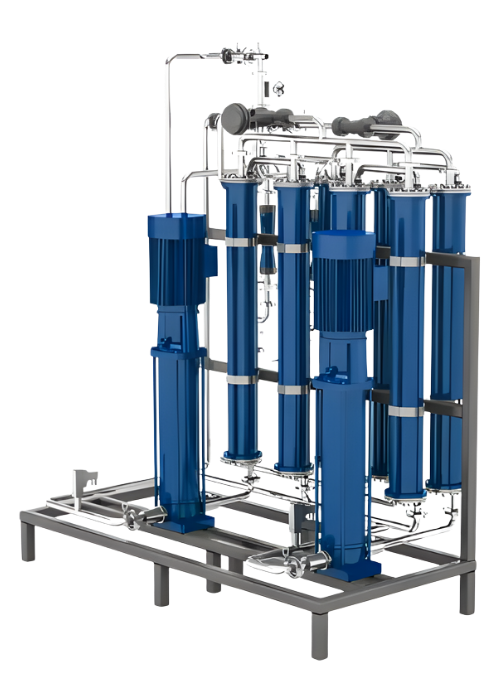
High-purity hydrogen determines the yield of fuel cells, synthesis, and storage. Within this process, Seals for hydrogen purification ensure separation between process streams and prevent contamination and emissions. Because hydrogen diffuses and purification is often cyclic, this requires materials with low permeation, controlled compression, and consistent tightness over thousands of cycles. Therefore, engineers place Seals for hydrogen purification at the center of design and validation, not as an afterthought but as a critical system decision.
Purity protects catalysts, prevents membrane damage, and stabilizes efficiency. Seals for hydrogen purification keep oxygen, moisture, and hydrocarbons out of the product path and prevent back-mixing. In practice this means predictable leak rates, reproducible pressure profiles, and stable efficiency. Therefore include in design FMEAs: exactly where do Seals for hydrogen purification impact safety, quality, and energy consumption?
PSA operates with pressure switching across adsorbents, catalytic steps break down residual gases, and electrochemical separation uses membranes to selectively transport hydrogen. In all cases, interfaces and gaskets determine the measurable leak-tightness. Seals for hydrogen purification must compensate tolerances, withstand temperature swings, and remain chemically inert so that the purification path is not disturbed by leaching. In cyclic PSAs this is especially challenging.
Hydrogen requires minimal gas permeability. Therefore, many engineers choose low-permeation seals and perfluoroelastomers with broad chemical resistance, e.g., FFKM Simriz®. This way, Seals for hydrogen purification remain stable with acids, bases, and catalytic residual components and limit weeping. In membrane systems, this prevents contaminants from impairing separation performance, while hydrogen loss remains demonstrably low.
Purification systems often switch from low to high pressure and back. During rapid decompression, there is a risk of internal crack formation. Seals for hydrogen purification therefore use AED/RGD-resistant O-rings that survive pressure shocks without loss of integrity. Combine this with controlled surface roughness and guidance so that heat build-up and wear remain within the calculated tolerance band.
Repeatability starts with geometry. With ISO 3601 groove dimensions, Seals for hydrogen purification achieve predictable compression and measurement interchangeability between production lines. Where gap width or pressure is high, PTFE backup rings prevent extrusion and maintain sealing force, even during thermal cycling. This combination makes validation faster and maintenance planning more reliable. In critical flange interfaces, it serves as an additional safety layer.
Fast trips or control actions require AED/RGD-resistant O-rings that withstand decompression. For extreme chemistry and higher temperatures, FFKM Simriz® remains the reference. In this way, Seals for hydrogen purification retain their elastic properties, minimize permeation, and prevent catalyst poisoning. Use compound and batch traceability to demonstrate consistency toward QA and audits.
Validate with identical grooves, surface roughness, and torque settings as in the final device. Measure permeation, compression set, and leak rates under representative pressure and temperature profiles. Seals for hydrogen purification that pass these tests provide data for lifetime calculations, allowing maintenance to shift from reactive to plannable. Link results to energy consumption and product loss to make TCO visible. In this step, repeat with focus: where do Seals for hydrogen purification demonstrably improve the KPIs?
Work with high-purity compounds and clean surfaces. Minimize dead volumes, secure alignment, and prevent overcompression. In this way, Seals for hydrogen purification support clean processing and keep emissions below internal and external thresholds. A short checklist during overhauls: groove inspection, roughness measurement, torque check, and batch match of replacement parts.
PSA units: the cyclic pressure change is the bottleneck. Choose AED/RGD-resistant O-rings and ensure proper guidance to keep friction low. PTFE backup rings are useful where gap width increases, for example with larger flange diameters or thermal expansion. For longer stable operation, it is beneficial to combine low-permeation seals with a compound featuring low compression set. In purge and equalize valves, Seals for hydrogen purification minimize product gas loss and prevent back-mixing with air.
Catalytic purification: here, chemical resistance and cleanliness dominate. Choose FFKM Simriz® or PTFE contact layers where oxidizing or reducing components are present. Pay attention to leaching: a filler-rich elastomer can release trace contaminants that poison the catalyst. With ISO 3601 groove dimensions, you can maintain tight tolerances and prevent overcompression that shortens service life.
Electrochemical separation: stacks require uniform contact and limited permeation. Seals for hydrogen purification must be mechanically compliant to compensate for tolerances but chemically inert to avoid stressing the membrane. In cooling plates and end plates, PTFE backup rings provide support against extrusion during heating and cooling cycles. Batch traceability remains mandatory, as small variations in elastomer formulation are noticeable in leak curves.
For gas purification systems with high pressure and chemical stress, FFKM Simriz® compounds and AED/RGD-resistant O-rings are the best choice.
With high pressure differentials or large gap widths; they prevent extrusion and keep the sealing pressure stable.
Standardized grooves provide reproducible compression and interchangeability between suppliers.
By permeation, decompression, and compression set testing under identical process pressure and temperature as in the installation.
Do you have questions about ?
Fill out the form below and we will assist you!



 Nederlands
  Deutsch