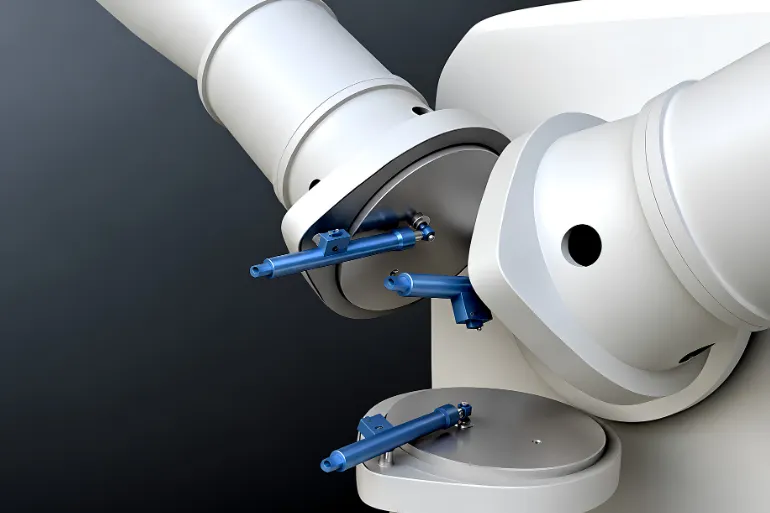
Hydraulic pitch cylinders adjust the rotor blades of a wind turbine. During operation, they perform numerous short corrective movements, repeatedly subjecting the seals to mechanical loads. Wipers, rod seals, piston seals and guide rings each serve a different purpose: keeping contaminants out, limiting oil leakage or supporting moving components. Material selection depends on these functions. High-temperature UHMW-PE, such as compound AF-7720, can be an interesting material option for pitch cylinders. Whether this material is suitable depends not only on its temperature limit but also on the complete system of hydraulic seals.
In a hydraulic pitch system, the cylinders are located inside the rotating rotor hub. The linear movement of the piston rod is converted into rotation of the rotor blade around its longitudinal axis through a mechanical linkage. Control valves direct hydraulic fluid to the cylinder, allowing the blade pitch angle to be adjusted according to operating conditions. Pitch control therefore helps regulate energy output and reduce mechanical loads. Pitch cylinders also form part of the emergency pitch system: stored hydraulic energy from accumulators can be used to move the blades into the feathered position. The complete safety concept therefore involves more than just the cylinder. Not every wind turbine uses this configuration; electric pitch systems are also available.
Pitch cylinders frequently perform short strokes at a high repetition rate during blade pitch adjustments. As a result, the seals repeatedly move over a limited section of the mating surface. Lubrication of the contact surface requires particular attention during these micro-movements. A seal profile that locally retains oil can help maintain lubrication in the contact zone. In addition, the system must respond to varying pressures and changes in movement direction. Excessive friction can cause stick-slip: alternating sticking and sliding, resulting in jerky movement. Temperature also affects operating conditions, partly because oil viscosity changes. Material selection for pitch cylinders therefore involves more than just wear resistance. The seal profile, fluid film and operating loads must be evaluated together to limit leakage and unnecessary resistance during movement.
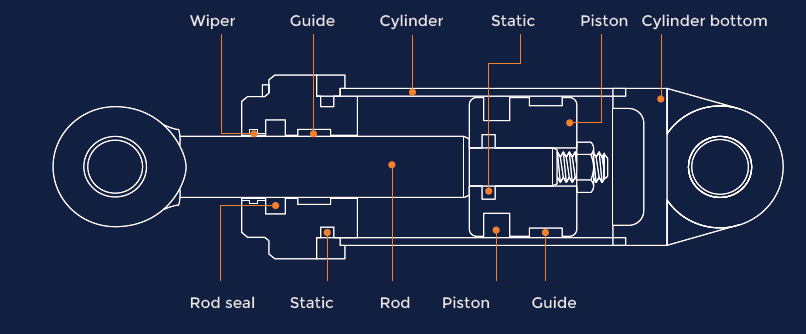
The wiper is located on the outside of the cylinder head, where the piston rod extends out of the cylinder. During retraction, the wiping lip removes dirt, moisture and other contaminants from the rod. This helps protect the seals and guiding elements behind it. In pitch cylinders, the wiping function must be suited to the environmental conditions and the lubrication requirements of the rod. A double-acting design can also control the outgoing oil film. However, the wiper does not replace the rod seal: keeping contaminants out and sealing hydraulic pressure remain separate functions within the same system.
Rod seals are installed in the cylinder head and seal against the moving piston rod. They limit hydraulic fluid leakage to the outside. The short movements of pitch cylinders require a balance between sealing performance, friction and lubrication. Possible designs include a polyurethane lip seal or a polymer sliding ring with an elastomeric energizing ring. In the latter configuration, the sliding ring makes contact with the rod, while the elastomeric component provides the preload. Sealing performance therefore depends on the interaction between the seal profile and its materials, rather than solely on the properties of the polymer.
Piston seals are installed on the piston and seal against the inner wall of the cylinder bore. They limit fluid flow between the chambers on either side of the piston. This allows the necessary pressure differential to develop and generate force. In double-acting pitch cylinders, the sealing arrangement must be able to withstand pressure from both directions. A polymer sealing element can be combined with an elastomeric energizing ring for this purpose. In addition to controlling leakage, attention must be paid to the response to pressure reversals and resistance to extrusion, particularly when temperature and clearances between components increase.
Guide rings support the piston and piston rod. They absorb lateral forces and help prevent direct metal-to-metal contact between components. Unlike rod and piston seals, their primary function is guidance rather than pressure sealing. When selecting guide rings for pitch cylinders, not only sliding properties but also load-bearing capacity and dimensional stability must be considered. A material with low wear does not automatically make it suitable for every radial load. Resistance to creep, meaning time-dependent deformation under load, must also be evaluated at the intended operating temperature.
Various materials are used for seals in pitch cylinders, depending on their function and operating conditions. Polyurethane (PU) is widely used due to its combination of wear resistance, flexibility and mechanical strength. PTFE is suitable for certain dynamic seals where low friction and controlled sliding behaviour are important. UHMW-PE, an ultra-high-molecular-weight polyethylene, also offers favourable properties such as wear resistance, self-lubrication and extrusion resistance. Special high-temperature compounds, such as AF-7720, have been developed to better retain these properties at elevated temperatures. For pitch cylinders, the final material selection must be matched to the hydraulic fluid, pressure loads, movement frequency and temperature. In addition, seal geometry, groove dimensions and the surface finish of moving components are decisive factors for reliable operation.
When maintaining pitch cylinders, attention should be paid to the entire sealing system. Inspect not only visible leakage along the piston rod, but also the wiper, guiding elements and condition of the metal contact surfaces. A damaged wiping lip, scratches on the rod or permanently deformed guide rings may indicate the need for further investigation into the underlying cause. During overhaul, document where material has worn away and whether there are signs of extrusion. Compare these wear patterns with the operating temperature, pressure loads and condition of the hydraulic fluid. Simply replacing a seal may not be sufficient if the underlying cause remains unresolved. Inspection and replacement should follow the procedures specified by the cylinder and turbine manufacturers. Without application-specific data, it is not possible to reliably determine a fixed service life for all seals.
No, both hydraulic and electric pitch systems exist. The configuration depends on the turbine platform; the manufacturer's name alone does not indicate which system is used.
A rod seal limits external leakage along the piston rod. A piston seal limits internal leakage between the chambers on either side of the piston.
Guide rings absorb radial loads and help prevent metal-to-metal contact. They support movement but do not take over the pressure-sealing function of rod and piston seals.
High-temperature grades have been developed to retain their properties at elevated temperatures. Performance depends on the specific compound; for AF-7720, Accofluor highlights properties including wear resistance and dimensional stability.
Accofluor specifies 120 °C as the upper temperature limit but does not define continuous dynamic operating conditions in the material datasheet. The permissible temperature of a complete seal must therefore be confirmed for the specific load and hydraulic fluid.
Do you have questions about ?
Fill out the form below and we will assist you!



 Nederlands
 Deutsch