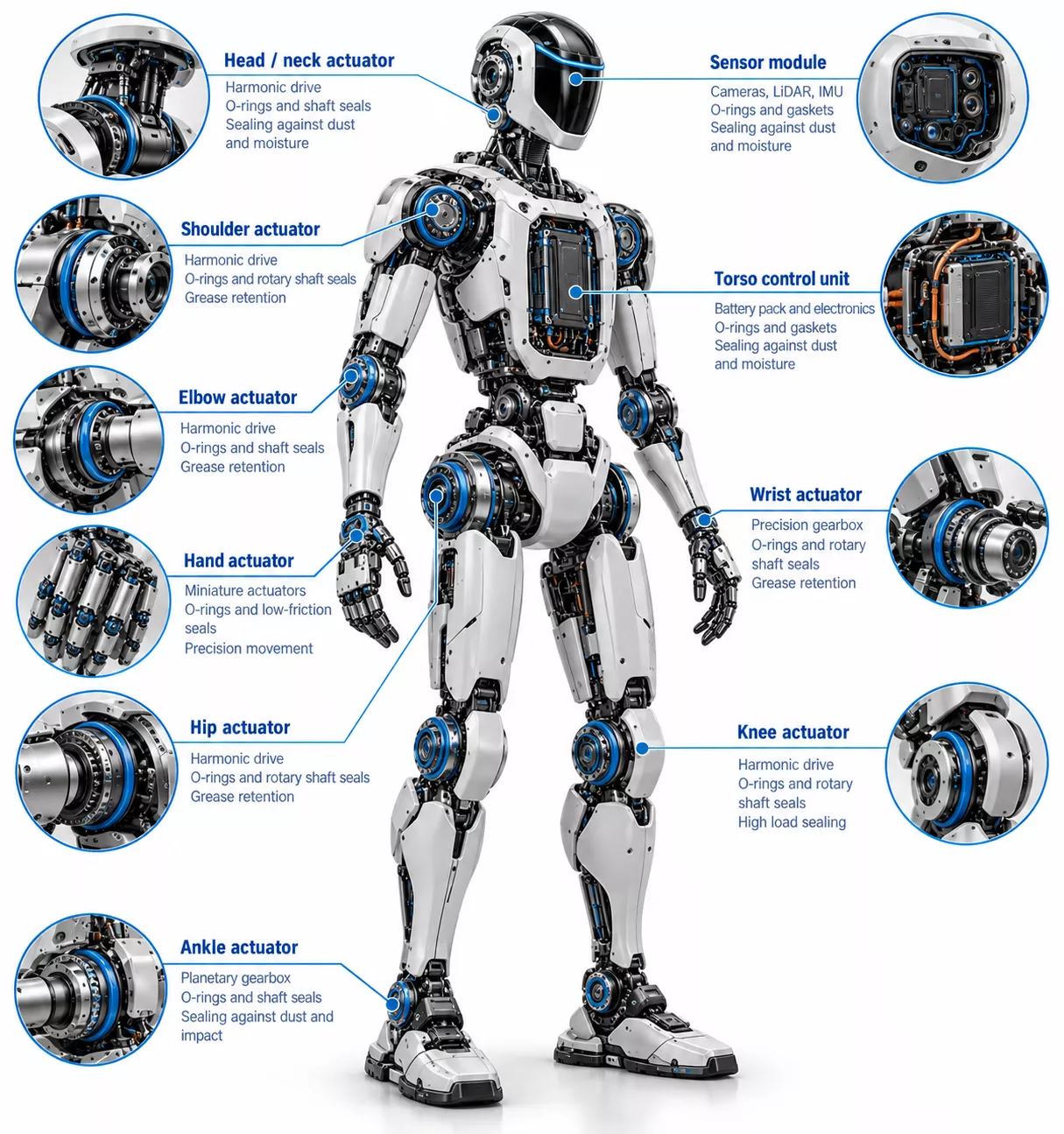
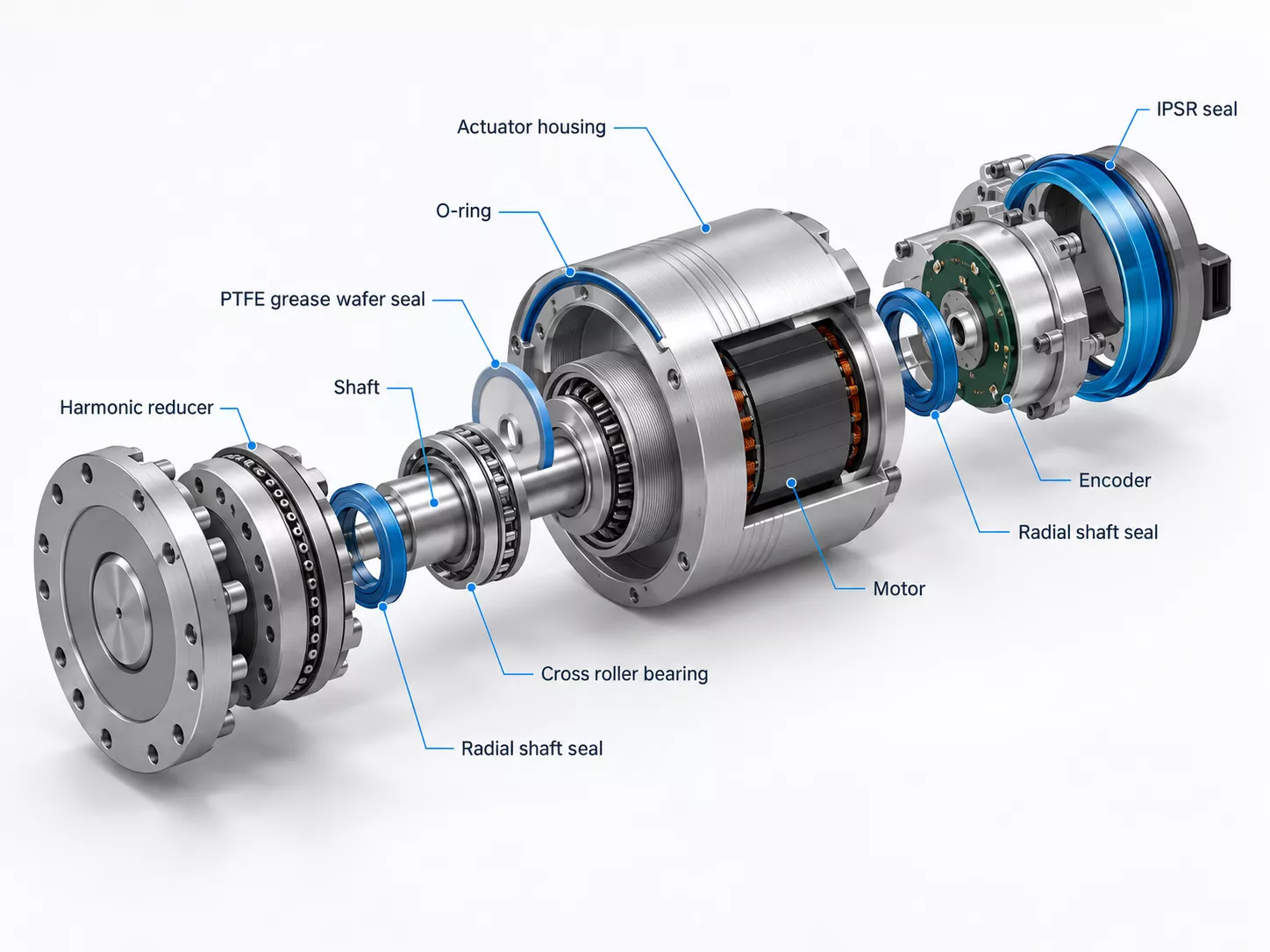
Humanoid robots have joints that allow them to walk, grip objects and move their arms. These movements are driven by actuators containing motors, gearboxes and bearings. Seals are required at various points to protect these components. They retain lubricants within the drive system and help prevent moisture and dirt from entering. The type of seal used depends primarily on the design: a static housing joint requires a different sealing solution than a rotating shaft. Therefore, both conventional O-rings and specially designed dynamic seals may be suitable for use in humanoid robots.
Most modern humanoid robots use electric actuators. An electric motor drives the joint through a transmission system. Inside this transmission, grease or oil lubricates the gears and bearings. If the lubricant escapes, the risk of wear increases. At the same time, dust and moisture from outside can cause damage. Seals therefore primarily protect the interfaces between stationary housing components and moving shafts. Seal selection involves more than just preventing leakage: a dynamic seal also creates resistance against the moving component. In a robot with dozens of actuators, this additional friction is relevant to motor load and energy consumption. The seal must therefore be suited to both the type of movement and the required level of protection.
Shoulders, elbows, wrists, hips, knees and ankles contain drive systems that allow the robot to control its posture and movements. In an electrically driven joint, seals may be present around the output shaft, at the transmission and between housing components. Compact hands and fingers may also have protected joint interfaces. Seals also play a role in battery modules and electronic enclosures, but here the focus is on protecting the housing. The exact configuration varies by manufacturer: not every joint uses the same transmission or sealing solution. This is why it makes sense to examine the function of each seal profile rather than assume that one solution is suitable for all robot joints.
Several sealing principles can be used alongside each other within an actuator. Static connections require reliable sealing without relative movement. For shafts and joints, the focus is on controlled contact during movement. Freudenberg Sealing Technologies identifies O-rings, PSS Sinus Seals, IPSR seals and compact PTFE Wafer Seals as potential solutions for humanoid robots. Some of these solutions have already been demonstrably used in humanoid robots, while others are presented as technically suitable options. Each of the following seal types serves a specific function.
O-rings can seal actuator housings, cover plates and other static connections. The elastomer ring is compressed in a groove, creating a seal between the contact surfaces. Groove dimensions, material selection and the lubricant used are key factors when choosing an O-ring. A standard O-ring is generally not the first choice as the primary seal for a continuously rotating shaft. Specialized dynamic sealing profiles are commonly used for this purpose.
Radial shaft seals seal the point where a rotating shaft exits a stationary housing. This keeps oil or grease inside the transmission. The PSS Sinus Seal is a specialized sealing solution from Freudenberg featuring a sinusoidal sealing lip. According to the manufacturer, this technology has already proven effective in industrial robot motors and gearboxes. PSS is mentioned as a potential solution for humanoid robot drives, but this does not mean that every humanoid robot uses this type of seal.
IPSR stands for Ingress Protection Seals for Robotics. These sealing profiles protect moving interfaces against water and dirt, including those in compact joints. According to Freudenberg, an IPSR seal is already being used by a manufacturer of humanoid robots. The design focuses on limited installation space, low friction and the ability to accommodate certain relative movements. However, the protection rating of the complete joint also depends on the design of the surrounding housing.
PTFE Wafer Seals are thin seals that can retain lubricants within a compact drive system. Their flat design is particularly useful when axial installation space is limited. PTFE offers favorable sliding properties, but the actual friction also depends on the seal profile geometry, contact pressure and running surface. The suitability of these seals for a specific actuator must therefore be validated through design and testing.
For static O-rings, NBR and FKM may be suitable options, depending on the lubricating grease, temperature and operating conditions. NBR O-rings are often selected for applications involving compatible mineral oils and greases. FKM can offer advantages at certain higher temperatures and under chemical exposure. PTFE is relevant for specialized sliding seals, while polyurethane is used in sealing profiles designed for wear resistance. However, the material family alone is not sufficient to determine suitability. For humanoid robots, the exact compound must be evaluated against the lubricant, temperature, contact load and type of movement. Installation and groove geometry also play a role. After all, a suitable material in an unsuitable seal profile does not automatically provide reliable sealing.
The main design consideration for dynamic seals in robots is how much contact pressure is needed to provide effective sealing without causing unnecessary friction. Higher resistance increases the energy required to drive the actuator and can affect small, precisely controlled movements. Wear also depends on lubrication, surface roughness, alignment and the number of movement cycles. During inspection, traces of grease around a shaft or contamination inside the housing may indicate a sealing problem, but the underlying cause must be determined separately. For humanoid robots that operate for extended periods under varying conditions, testing under actual operating loads is more important than a general indication of material service life. This helps determine whether the seal performs as intended within the complete actuator.
Depending on the design, O-rings, radial shaft seals, IPSR profiles and PTFE Wafer Seals are among the sealing solutions used or considered. Each type serves a different function.
For example, between stationary actuator housings and covers. A specialized dynamic seal is generally selected for a rotating shaft.
An IPSR seal protects moving joint interfaces against moisture and dirt. Freudenberg reports that this type of seal is already being used in humanoid robots.
Friction increases the energy required by the actuator and can affect the control of small movements. A dynamic seal must therefore provide sufficient protection without creating unnecessary resistance.
Do you have questions about ?
Fill out the form below and we will assist you!



 Nederlands
 Deutsch