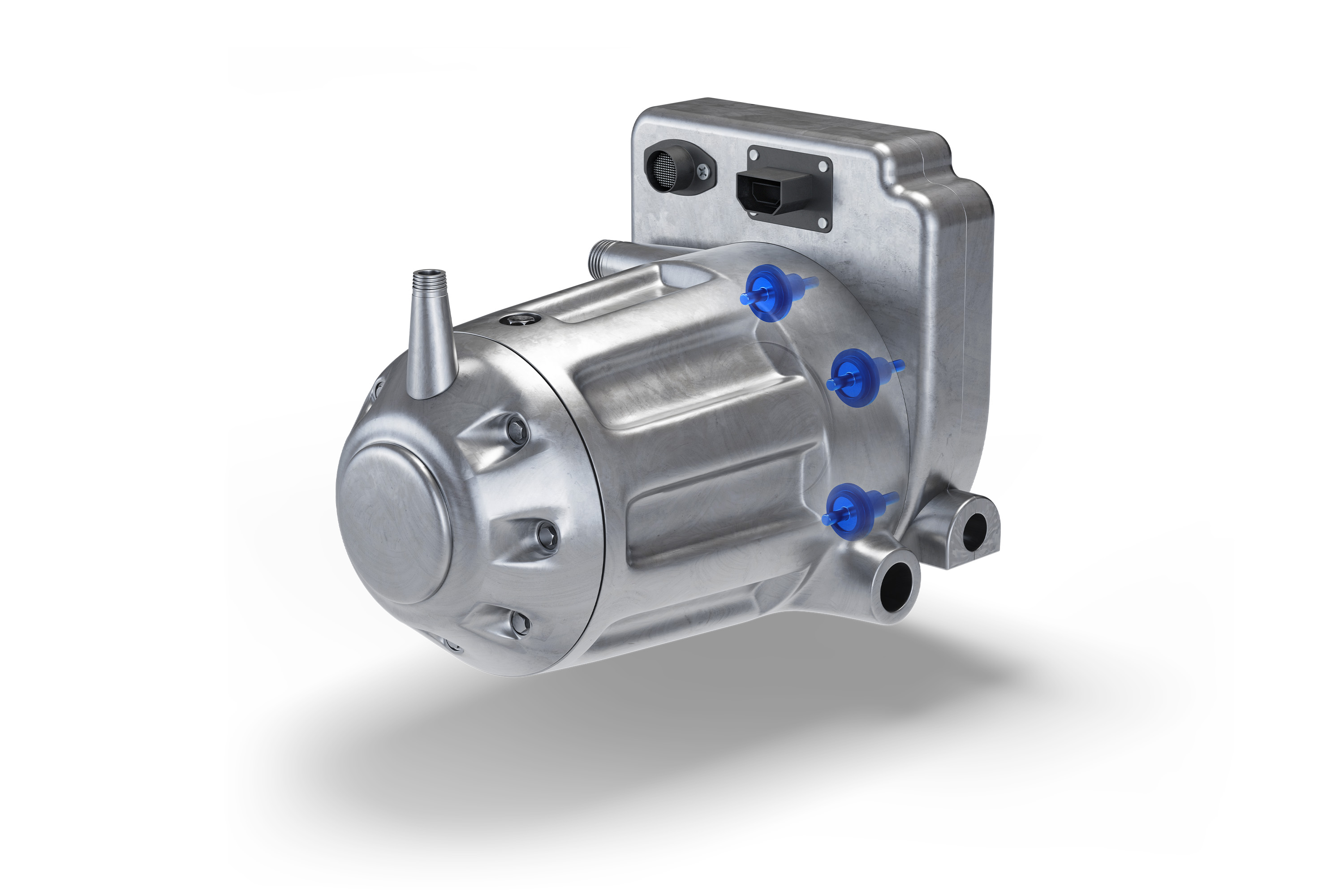
Freudenberg Sealing Technologies has developed a new sealing system for electrical feedthroughs in air-conditioning compressors for vehicles. The solution is intended for busbars and pins in compressor housings and was specifically developed for CO₂ compressors using R744 as the refrigerant.
The shift to natural refrigerants is changing the requirements for seals. In the automotive sector, R134a and R1234yf are increasingly being replaced by alternatives such as CO₂ and propane. CO₂ in particular places high demands on a seal, because the pressure in these compressors is significantly higher than with conventional refrigerants.
Permeation plays a major role in CO₂ compressors. CO₂ molecules can penetrate elastomer material. If the pressure then drops quickly, trapped gas molecules can expand and damage the seal from the inside. This is known as explosive decompression.
For busbar sealing, this is especially critical. The seal must not only withstand pressure and media, but also reliably insulate electrical feedthroughs. Freudenberg therefore uses elastomer variants with a high Comparative Tracking Index (CTI), so that leakage currents at the busbar feedthrough are prevented.
According to Freudenberg, the new sealing system withstood pressures of more than 100 bar in leak tests. The solution was developed based on a combination of material selection, sealing contour and manufacturability.
Freudenberg therefore positions the seal as an alternative to traditional glass seals. Depending on the application, the company says the cost per sealed busbar or pin can be up to 30% lower. Since a compressor usually contains three busbars, this can make a relevant difference in series production.
In addition to cost, Freudenberg also mentions compactness and flexibility as advantages. In modern compressor environments, the available installation space is limited. A compact elastomer sealing system can be adapted to this more effectively than a standard glass solution.
According to Freudenberg, the material portfolio covers a temperature range from -40 °C to more than 200 °C. The seals were developed for CO₂, but may also be suitable for other refrigerants and high-pressure applications.
Freudenberg is now working with several compressor manufacturers on concrete development projects. The first prototypes have been validated. The technology is therefore not only interesting for CO₂ air-conditioning compressors, but possibly also for other applications where high pressure, electrical feedthroughs and media resistance come together.
For sealing technology, this is a clear example of how the energy transition and new refrigerants directly influence seal design. Here, a seal must not only remain leak-tight, but also be electrically safe, compact and resistant to extreme pressure fluctuations.
Source
Freudenberg Sealing Technologies. (2026, May 7). Perfect hold: Even at over 100 bar. https://www.fst.com/news-stories/press-releases/2026/busbars-compressors/
Do you have questions about ?
Fill out the form below and we will assist you!



 Nederlands
 Deutsch