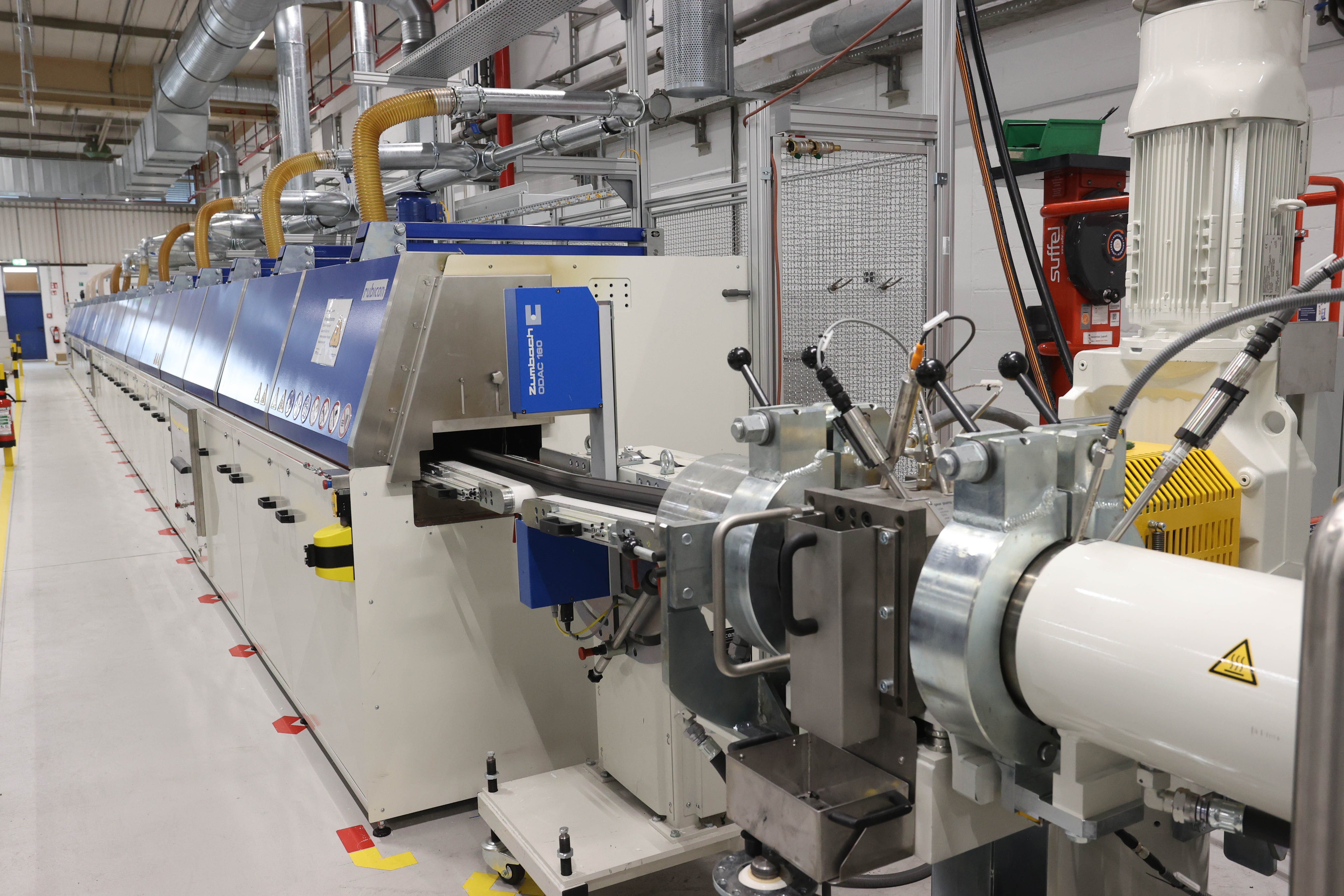
Freudenberg Sealing Technologies has commissioned an extrusion line for seal profiles that are vulcanized using molten salt. With this, the company is expanding its portfolio with vulcanized materials and geometries for demanding technical applications. The announcement states that vulcanized materials are essential in application areas with high requirements for wear resistance and chemical resistance, elasticity, and durability, such as aerospace, food & beverages, and the energy sector.
With LCM (Liquid Curing Method), Freudenberg describes a vulcanizing extrusion process in which the vulcanization medium consists of molten salt heated to around 200 °C and supplemented with curing salt. The entire production line operates in a closed loop, in which the salt is continuously recycled, fed back into the process, and reused. The text also states that the molten salt ensures uniform heat transfer without exposure to oxygen.
The extrusion line is 36 meters long, with a 19-meter-long salt bath at its core. At the start of the line there are two mobile extruders on specially installed rails that can be deployed as needed, allowing the system to switch from fine, millimeter-scale geometries to large sealing cross-sections. The extruded profile is vulcanized in the molten salt in a continuous process. First, the profile is sprayed with hot liquid salt in a trickling section, which, according to the text, vulcanizes the outer surface and provides dimensional stability. This is followed by full immersion in the hot salt and conveyance through a roller section within the salt bath. Next, the profile is gently moved in a beater section so that the liquid salt can drain off. Finally, any remaining salt is removed in a combined washing, cooling, and blow-off section, and the profile cools back down to room temperature. The announcement states that this production process makes it possible to respond flexibly and quickly to customer-specific requirements in material selection and development.
According to the text, the LCM process makes it possible to use different crosslinking systems, including peroxide crosslinking, in one continuous line. This allows Freudenberg to process a wide range of elastomers; the announcement mentions the material groups NBR, EPDM, and FKM, with additional material groups under development. The text links the new LCM installation to growth markets and industrial applications. For wind farms, it describes the trend toward larger turbines and the associated requirement for foundation seals to compensate for large gap movements over long periods, even under extreme storm conditions, with expected service lives of up to 35 years or more. Freudenberg refers to both large-scale seal profiles and existing seal sizes with improved materials, with LCM expanding the available options.
For hydrogen production, alkaline electrolyzers are mentioned, which require materials and seal dimensions that can withstand potassium hydroxide (KOH), where large diameters may sometimes be combined with very delicate profiles and high tolerance requirements. The process industry is also referenced, with large seals that must be able to withstand aggressive media and high temperatures, with examples such as lids and covers in soldering systems and hot-air ovens in the food industry. According to the text, molten-salt vulcanization can be leveraged here because LCM provides access to an extensive materials portfolio and enables very precise production of both small and large cross-sections. For documented monitoring, Freudenberg describes an integrated sensor system that measures product characteristics during vulcanization and a control system that adjusts the process based on the not-yet-vulcanized profile. The text states that filigree-fine profiles with a 1 mm wall thickness can now be produced with a tolerance of 0.1 mm, compared to the previously common 0.3 mm, and that customers gain access through this process to a breadth of materials that was previously mainly available via molding processes, including sealing solutions approved under U.S. Food and Drug Administration (FDA) regulations.
Source
Freudenberg Sealing Technologies: “Process Engineering: New Extrusion Process For Seal Profiles” (Weinheim, 3 November 2025).
Do you have questions about ?
Fill out the form below and we will assist you!



 Nederlands
 Deutsch