23 results
The GS10 is a PTFE bronze guide band for hydraulic applications and standard cylinders. The profile can be used to guide pistons and piston rods. In both positions, the guide band dissipates transverse forces and supports the concentricity of the moving components within the cylinder.
The GS10 also reduces the risk of metallic contact between the moving components and the surrounding cylinder structure. The guide band is manufactured as roll material, cut to the required length and installed in a closed, cut groove.
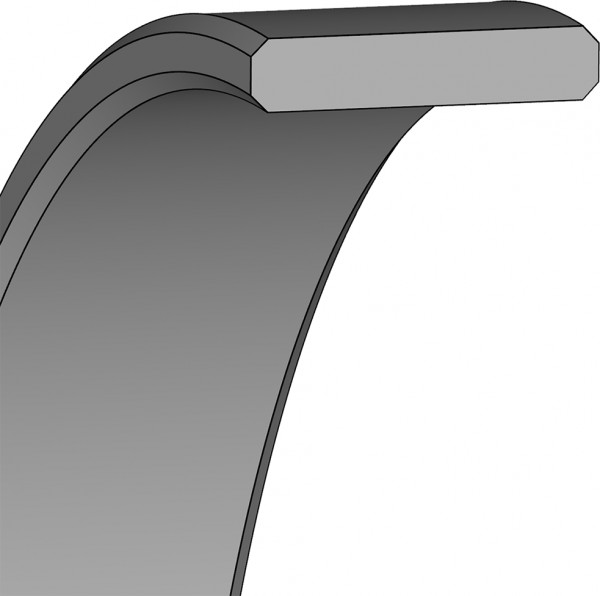
The GS10 is made of PTFE bronze. The profile has a smooth surface and is chamfered on both sides. According to the datasheet, the guide band does not contain any additional components or separate preloading elements.
According to the datasheet, the combination of PTFE bronze and the smooth surface results in low friction and a minimised stick-slip effect. The chamfers on both sides also support simple installation in the intended groove.
The GS10 guide band can be used to guide both a piston and a piston rod. In both positions, the profile dissipates transverse forces and helps keep the moving components concentric within the cylinder.
By reducing the risk of metallic contact, the guide band contributes to an extended cylinder life according to the datasheet. The GS10 therefore performs a guiding function without being described as the primary pressure seal.
The GS10 has a smooth surface. In combination with the PTFE bronze material, this provides low friction and a minimised stick-slip effect during movement of the piston or piston rod according to the datasheet.
The guide band can be used at sliding speeds of up to 15 m/s. Actual suitability remains dependent on the combination of sliding speed, dynamic contact pressure, temperature, medium and other operating conditions.
The GS10 is intended for hydraulic systems and standard cylinders. The profile can be used around a piston or piston rod and is suitable for a broad spectrum of moderately demanding applications in general industry.
According to the datasheet, the guide band offers high chemical resistance, low friction and simple installation. The profile also has a good price-performance ratio and is manufactured by certified external suppliers.
The GS10 is specified exclusively with PTFE bronze as its material. The profile has a temperature range of -60 to +200 °C. The maximum sliding speed is 15 m/s and the maximum dynamic contact pressure is 15 N/mm².
According to the datasheet, the GS10 has high chemical resistance. During material selection, the temperature, sliding speed, dynamic contact pressure and medium must be assessed together. The stated maximum values may not all be reached at the same time.
The GS10 is resistant to hydraulic oils according to DIN 51524 parts 1 to 3, lubricating oils and lubricating greases based on mineral oils. The guide band can also be used with the flame-retardant hydraulic fluids HFA, HFB and HFC according to VCMA 24317.
Media resistance must be assessed together with the temperature, sliding speed, contact pressure and other conditions within the application. The datasheet does not provide separate limit values for each medium.
The GS10 guide band can be used at temperatures from -60 to +200 °C. The maximum sliding speed is 15 m/s. The maximum dynamic contact pressure is 15 N/mm².
These figures are maximum limits and, according to the datasheet, may not all be reached at the same time. The transverse load, temperature, movement, contact pressure and medium must therefore be considered together during assessment.
Current information about approvals and certificates must be checked in the material data sheet applicable to the respective material. This information depends on the specific compound and, according to the datasheet, cannot be listed exhaustively in the general product information.
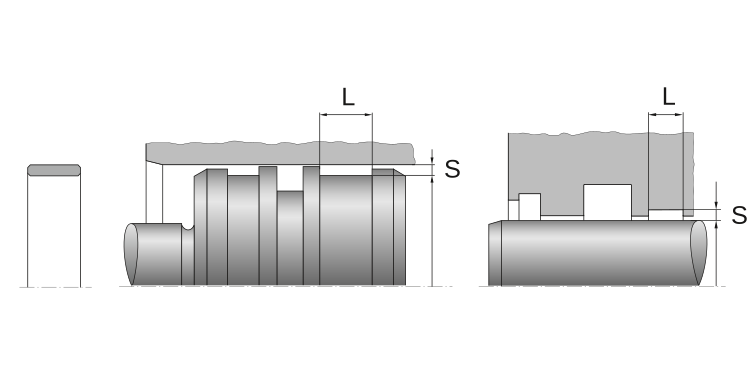
The cylinder housing and piston rod or piston must be chamfered to prevent damage during installation. The length and angle of the installation chamfers must correspond to the associated installation-space drawing.
The surface roughness of the mating surface must comply with the specifications of the seal used. The groove flanks for the GS10 may have a maximum surface roughness of Ra 3 µm. A maximum surface roughness of Ra 2.5 µm applies to the groove base.
The GS10 is manufactured as roll material and must be cut to the required length before installation. For guiding a piston rod, the datasheet specifies the formula 3.11 x (d + S) - 1.0. For guiding a piston, the formula is 3.11 x (D - S) - 1.0.
These formulas already include the coefficient of thermal expansion and the required gap dimension for the joint. The correct formula must be selected according to the position of the guide band around the piston rod or piston.
The GS10, cut to the required length, is installed in a closed, cut groove. The chamfers on both sides of the profile support installation. According to the datasheet, the guide band can be installed easily.
Before installation, check that the installation chamfers and surfaces are free from damage that could affect the guide band during fitting. The band length must be calculated using the correct formula and cut to size before the profile is inserted into the groove.
The GS10 must be stored at a temperature below 25 °C. During storage, the guide band must not be exposed to direct heat sources or direct sunlight. Condensation in the storage room must also be prevented.
The product must also be protected against ozone and ionising radiation. The storage recommendations in the datasheet are based on the revision of ISO 2230 dated 16 September 1992.
When selecting a GS10, first determine whether the guide band will be used around a piston or piston rod. Then determine the required width and cut length for the closed groove, using the formula that corresponds to the relevant guiding position.
Also assess whether PTFE bronze is suitable for the medium and whether the temperature range of -60 to +200 °C, maximum sliding speed of 15 m/s and maximum dynamic contact pressure of 15 N/mm² match the operating conditions. The transverse forces, surface quality and installation chamfers must also be checked. If an approval or certification is required, it must be established separately for the selected compound.



 Nederlands
 Deutsch