541 - 547 of 547 results
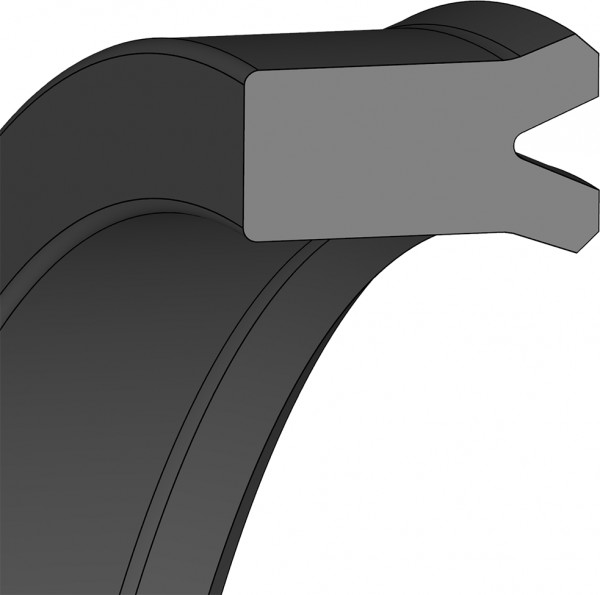
The N25 is a symmetrical U-ring for hydraulic applications. Its symmetrical profile allows the same seal to be used as a rod seal or a piston seal, depending on its installation position.
The profile is single acting and intended for one-sided pressure load. During installation, the seal must therefore face the side from which the hydraulic pressure is applied.
When used as a rod seal, the N25 is installed around the moving piston rod. At this position, the seal provides good static and dynamic sealing under one-sided pressure load.
The piston rod must be oiled or greased before installation. The dimensions, pressure direction, groove design and surface quality of the mating surface must also correspond to the selected version.
When used as a piston seal, the N25 is installed on the piston. The symmetrical profile enables this application without requiring a separate profile version.
For this application, the data sheet specifies that the piston seal must be greased before the cylinder is assembled. The installation direction must also correspond to the one-sided pressure load.
The N25 has a symmetrical profile with a recessed sealing lip. The complete sealing profile is made of TPU.
The robust design supports its use as a rod or piston seal. The recessed sealing lip contributes to the profile’s good static and dynamic sealing performance.
The symmetrical shape is a defining characteristic of the N25. It allows the profile to seal either a piston rod or a piston, depending on the installation arrangement.
In both applications, the N25 remains a single-acting seal. The pressure direction and position of the sealing lip must therefore be checked before installation.
The data sheet describes the N25 as a robust seal with a long service life. The profile also provides good static and dynamic sealing performance.
These properties apply within the specified operating limits. Temperature, pressure, sliding speed, medium and installation conditions must therefore be assessed together.
The N25 U-ring is intended for mobile hydraulics. The profile has a wide application range as a rod or piston seal and is described as a reliable design for moderately demanding applications in general industry.
The stated advantages include simple snap-on assembly, a robust design, a long service life and good static and dynamic sealing performance. The N25 also offers a good price-performance ratio and is manufactured by certified external suppliers.
The N25 is made of TPU. This material forms the complete sealing profile and is used for both the rod-seal and piston-seal applications.
When assessing the material, temperature, pressure, sliding speed and the applied medium must be considered together. Any approvals and certificates depend on the specific compound.
The N25 is suitable for hydraulic oils in accordance with DIN 51524 parts 1-3 and for lubricating oils. The seal can also be used with mineral oil-based lubricating greases.
The flame-retardant hydraulic fluids HFA, HFB and HFC according to VCMA 24317 are also specified. During selection, verify that the applied medium falls within the stated compatibility of the compound.
The N25 has an operating temperature range from -40 to +100 °C. The maximum sliding speed is 0.5 m/s and the maximum permissible pressure is 30 MPa.
These operating limits are maximum values and may not all be reached simultaneously. Suitability should therefore be assessed using the complete combination of temperature, pressure, sliding speed, medium and installation conditions.
Consult the valid material data sheet for current information about approvals and certificates. This information depends on the specific compound and therefore cannot be listed exhaustively for every version.
The cylinder housing and piston rod or piston must be provided with chamfers to prevent damage to the seal. The length and angle of these installation chamfers must correspond to the installation-space drawing.
The groove flanks require a surface roughness of Ra ≤ 3 µm. The groove base must have a surface roughness of Ra ≤ 1.8 µm. The mating surface requires a surface roughness of Ra ≤ 0.4 µm.
The N25 can be installed in a closed, cut groove. An axially accessible installation space is required for small diameters. For inside diameters larger than 25 mm, the profile can be installed in a cut groove.
The selected groove configuration must correspond to the dimensions and the relevant rod-seal or piston-seal application. Always consult the associated installation drawing.
Deburr sharp edges and provide smooth chamfers and radii. Clean the installation space carefully before installation and remove dust, dirt, metal chips and other contaminants.
Do not pull the seal over sharp edges, threaded ends or recesses such as feather key grooves. Use a mounting sleeve where necessary to protect the profile. Heating the seal in oil to 80 °C makes the material more elastic and facilitates installation.
When used as a rod seal, the piston rod must be oiled or greased before installation. When used as a piston seal, the seal must be greased before the cylinder is assembled.
Store the N25 at a temperature below 25 °C. Avoid direct sources of heat, direct sunlight and condensation in the storage area.
The seal must not be exposed to ozone or ionising radiation. The storage recommendations are based on the revision of ISO 2230 dated 16 September 1992.
First check the required dimensions and determine whether the N25 will be used as a rod seal or a piston seal. Then align the installation direction with the one-sided pressure load and select the correct groove configuration for the relevant diameter.
Also assess the temperature range from -40 to +100 °C, the maximum sliding speed of 0.5 m/s and the maximum pressure of 30 MPa. These values may not all be reached simultaneously. Check the medium, surface requirements, installation conditions and any compound-dependent approvals.



 Nederlands
 Deutsch
.svg)