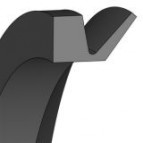
A V-ring seal is a type of all-rubber seal that is designed to prevent the ingress of dirt, dust, water, or other contaminants, while also keeping lubrication in place. It’s often used in applications where rotating shafts need a seal that doesn’t cause excessive friction or wear.
V-rings serve as : lip seals or flinger rings. They are used as a seal against dust, dirt, grease, oil or water splashes from outside. The V-ring rotates with the shaft and seals axially against the counter surface. V-rings are mainly used in combination with other seals, such as radial shaft seals, but also as a pre-sealing element for bearings. Because they are available in different types, V-rings offer high flexibility in use for pressure-free operations. Typical applications for V-rings are rolling mills, agricultural machinery and electric motors.
Materials for V-rings : NBR, Viton, and EPDM
NBR (Nitrile Butadiene Rubber):
Properties: Good resistance to oils, fuels, and other petroleum-based products. It has good mechanical properties and wear resistance.
Temperature Range: -40°C to +100°C (some grades go up to +120°C).
Applications: Common in automotive, oil, and gas industries.
Viton (Fluoroelastomer):
Properties: Excellent chemical resistance, particularly to aggressive chemicals, fuels, and high temperatures. Viton also has good resistance to ozone, UV, and weathering.
Temperature Range: -20°C to +200°C (can go higher with specific grades).
Applications: Aerospace, chemical processing, and industrial applications with high-temperature requirements.
EPDM (Ethylene Propylene Diene Monomer):
Properties: Excellent resistance to weathering, ozone, UV, and water. It has poor resistance to oils and fuels, making it suitable for outdoor applications but not for environments with petroleum exposure.
Temperature Range: -50°C to +150°C.
Applications: Water and steam systems, outdoor and weather-exposed applications, HVAC.
Key Considerations for V-ring material choise
NBR is typically the choice for v-ring applications involving oil or fuel exposure.
Viton is preferred for v-ring high-temperature and chemical-intensive environments.
EPDM works best in v-ring weather-resistant applications where oils and fuels are not present.
The choice between NBR, Viton, and EPDM for a V-ring seal depends on the specific operational environment and the substances the seal will encounter.
All types of V-rings
VA V-ring, VAX V-ring, VE V-ring, VL V-ring, VLX V=ring VRME V-ring , VS V-ring, VXL V-ring
Didn't find the right V-Rings Dichtomatik? Complete the form below and we will help you!
This website uses cookies
We use cookies to improve user experience and display personalized advertisements. Choose what cookies you allow us to use. You can read more about our Cookie Policy in our Privacy policy.
Privacy statement.
Learn how Google uses personal data when you give consent. Google Privacy statement.




 Nederlands
 Deutsch


