1 - 30 of 76 results
The AD60 is a double-acting wiper for short-stroke cylinders with high sliding speeds and high stroke frequencies. The wiping edge removes dirt and other contaminants from the piston rod as it retracts into the cylinder. In this way, the profile helps prevent contamination from the outside from entering the installation space.
A second lip reduces the residual oil film on the surface of the piston rod. The AD60 therefore combines the removal of dirt with the reduction of residual oil. The composite profile consists of a PTFE bronze base element and an NBR O-ring.
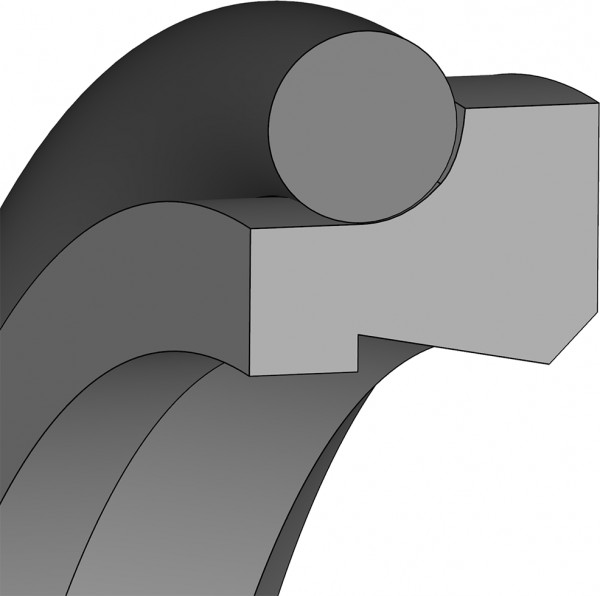
The base element of the AD60 is made of PTFE bronze and contains a sealing and wiping edge. A separate NBR O-ring serves as the sealing and preloading element. No metal angle ring is present.
The O-ring applies preload to the PTFE bronze base element. According to the datasheet, this preloading provides static tightness. The combination of the base element and O-ring therefore forms both the dynamically functioning lips and the static seal in the installation space.
As the piston rod retracts, the wiping edge removes contaminants from the rod surface. The second lip reduces the residual oil film. This combination is why the AD60 is described in the datasheet as a double-acting wiper.
A pressure relief hole is recommended for returning the residual oil. The preload provided by the NBR O-ring also supports static tightness. According to the datasheet, the profile combines good wiping properties with low friction and has no stick-slip effect.
The AD60 is suitable for short-stroke cylinders with high sliding speeds and a high stroke frequency. The maximum sliding speed is 15 m/s. The combination of low friction and the absence of a stick-slip effect supports its use with fast, repeated movements.
The datasheet also describes the AD60 as a reliable design with a broad application spectrum for moderately demanding applications in general industry. The profile has a good price-performance ratio and is manufactured by certified external suppliers.
The AD60 consists of two separate material components. The functional base element with the sealing and wiping edges is made of PTFE bronze. The O-ring that provides sealing and preloading is made of NBR.
During selection, both components must be assessed as part of the complete profile. The AD60 has a temperature range of -30 to +100 °C and a sliding speed of up to 15 m/s. According to the datasheet, the maximum values may not all be reached at the same time.
The AD60 is resistant to hydraulic oils according to DIN 51524 parts 1 to 3, lubricating oils and lubricating greases based on mineral oils. The profile can also be used with the flame-retardant hydraulic fluids HFA, HFB and HFC according to VCMA 24317.
The datasheet also lists hot air and steam under media resistance. During selection, the medium must be assessed together with the temperature range, sliding speed and other operating conditions.
The permissible operating temperature for the AD60 is between -30 and +100 °C. The maximum sliding speed is 15 m/s. These figures are maximum limits and, according to the datasheet, may not all be reached at the same time.
The temperature and sliding speed must therefore not be assessed separately from the medium, stroke length and stroke frequency. The dimensions, installation space and surfaces of the piston rod and groove must also be suitable for the composite profile.
Current information about approvals and certificates must be checked in the material data sheet applicable to the respective material. This information depends on the specific compound.
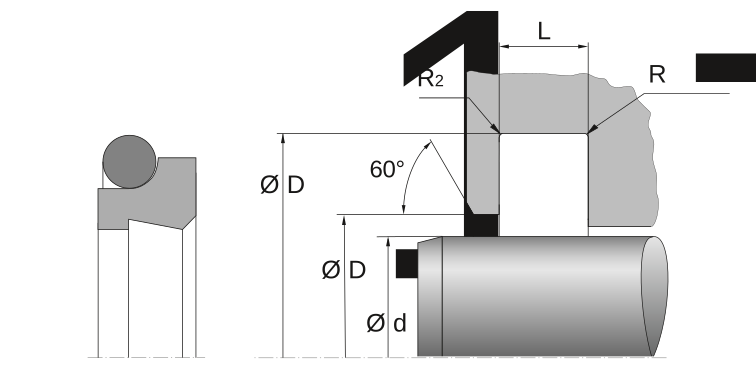
The cylinder housing and piston rod or piston must be chamfered to prevent damage during installation. The length and angle of these installation chamfers must correspond to the associated installation-space drawing.
The surface roughness of the piston rod must comply with the specifications of the seal used. The groove flanks for the AD60 may have a maximum surface roughness of Ra 4 µm. A maximum surface roughness of Ra 2.5 µm applies to the groove base.
For small diameters, an axially accessible installation space is required. Sharp edges must be deburred and the components must be provided with seamless chamfers and radii. Carefully clean the installation space and remove dust, dirt, metal chips and other contaminants.
When installing in a closed installation space, the PTFE part must be heated in advance. This allows the profile to be formed into a kidney shape and installed. The seal must not be kinked during this process. Do not roll the O-ring over the mounting surfaces and prevent the O-ring from twisting when it snaps into the groove. The seal must be calibrated after assembly.
The AD60 must be stored at a temperature below 25 °C. During storage, the wiper must not be exposed to direct heat sources or direct sunlight. Condensation in the storage room must also be prevented.
The product must also be protected against ozone and ionising radiation. The storage recommendations in the datasheet are based on the revision of ISO 2230 dated 16 September 1992.
When selecting an AD60, first check the required dimensions and accessibility of the installation space. Then assess whether the PTFE bronze base element and NBR O-ring are suitable for the medium and whether the temperature range of -30 to +100 °C and maximum sliding speed of 15 m/s match the operating conditions.
Also consider the stroke length, stroke frequency, both functional lips, preloading by the O-ring and the recommended pressure relief hole for returning residual oil. The installation chamfers, surface roughness and required installation and calibration steps must also be checked. If an approval or certification is required, it must be established separately for the respective compound.



 Nederlands
 Deutsch