9 results
The KNA16 is a single-acting seal for sealing pistons in hydraulic cylinders. The profile is specifically intended for cylinders with increased pressure requirements and is subjected to pressure from one side.
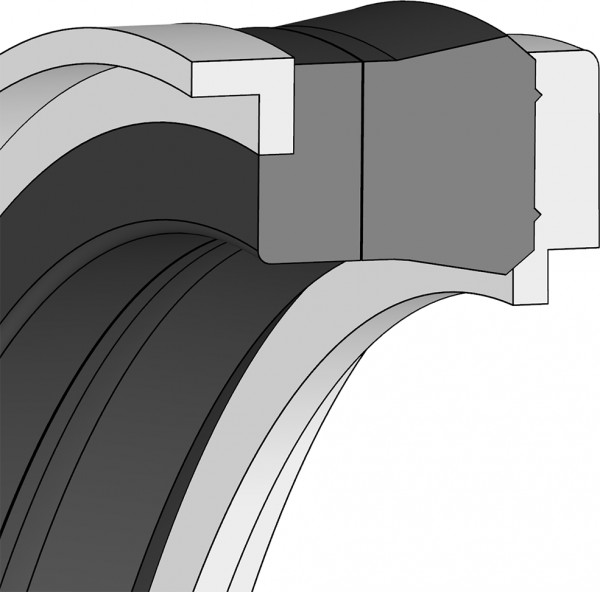
The piston seal has an asymmetrical construction, an external main sealing lip and a tight fit on the inside diameter. The supplied retaining ring is a functional part of the complete sealing system.
The sealing element of the KNA16 is made from NBR. Its back is reinforced with a combination of cotton fabric and NBR. POM is used for the guide element and retaining ring.
The external main sealing lip provides sealing on the outside of the profile. The retaining ring limits the installation space on the pressure-facing side, while the angle bushings function as integrated guide elements.
The KNA16 is a single-acting piston seal and is therefore designed for a one-sided pressure load. During installation, the main sealing lip and retaining ring must be positioned correctly in relation to the pressure side.
The asymmetrical profile makes the installation direction important. The pressure side must correspond to the position of the retaining ring that limits the installation space and supports the seal on the piston.
The back of the KNA16 consists of a combination of cotton fabric and NBR. According to the data sheet, this fabric section prevents the sealing material from being forced into the sealing gap under pressure.
This reinforcement contributes to the high extrusion reliability of the profile. The fabric-reinforced back is therefore an important part of the KNA16 for cylinders with increased pressure requirements.
The supplied POM retaining ring limits the installation space on the pressure-facing side. The ring also secures the seal on the piston.
According to the data sheet, the retaining ring enables deformation-free installation of the complete sealing system on the piston. It must therefore be installed together with the sealing element and integrated guide elements.
The angle bushings of the KNA16 function as integrated guide elements. POM is used for the guide element.
The guiding and sealing components are installed together within the same installation space. During assembly, all components must be positioned correctly in relation to each other and the pressure side.
The KNA16 hydraulic piston seal is intended for hydraulic applications and cylinders with increased pressure requirements. Its reliable design has a broad application spectrum and is suitable for moderately demanding applications in general industry.
The principal stated product advantage is high extrusion reliability. The KNA16 also offers a good price-performance ratio and is manufactured by certified external suppliers.
The sealing element of the KNA16 is made from NBR. Its reinforced back consists of cotton fabric and NBR. POM is used for the guide element and retaining ring.
During selection, these materials must be assessed in combination with the medium, temperature, pressure, sliding speed and conditions within the installation space.
The KNA16 is suitable for hydraulic oils according to DIN 51524 part 1-3 and for lubricating oils. The piston seal can also be used with lubricating greases based on mineral oils.
The specified media also include the flame-retardant hydraulic fluids HFA, HFB and HFC according to VCMA 24317. When selecting the seal, verify that the medium is suitable for the complete material combination of the sealing system.
The KNA16 hydraulic piston seal has a temperature range of -30 to +100 °C. Its maximum sliding speed is 0,5 m/s and the maximum permitted pressure is 50 MPa.
These application limits are maximum values and may not all be reached at the same time. The suitability of the seal must therefore be assessed using the complete combination of temperature, pressure, sliding speed, medium and installation conditions.
For current information about approvals and certificates, consult the material data sheet valid for the respective material. This information depends on the specific compound and cannot be listed exhaustively in the product data sheet.
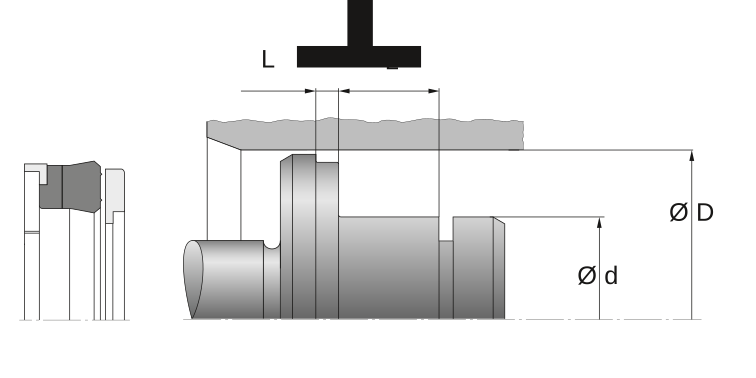
The cylinder housing and piston must be chamfered to prevent damage to the seal. The length and angle of these installation chamfers must correspond to the installation-space drawing.
The surface roughness of the groove flanks must be Ra ≤ 3 µm. The groove base must have a surface roughness of Ra ≤ 1,8 µm. A surface roughness of Ra ≤ 0,4 µm applies to the mating surface.
The KNA16 must be installed in an axially open groove. Deburr sharp edges and provide them with seamless chamfers and radii. Carefully clean the installation space before assembly and remove dust, dirt, metal chips and other contaminants.
Do not pull the seal over sharp edges, threaded ends or cavities such as feather key grooves during installation. Use a mounting sleeve if necessary to protect the components during assembly.
Grease the piston seal before fitting the cylinder. Position the supplied retaining ring on the pressure-facing side. This ring secures the seal and enables deformation-free installation of the complete sealing system on the piston.
The KNA16 must be stored at a temperature below 25 °C. Avoid direct heat sources, direct sunlight and condensation in the storage room. Do not expose the seal to ozone or ionizing radiation.
The storage recommendations are based on the revision of ISO 2230 dated 16.09.1992. Observe all specified environmental conditions during storage.
When selecting a KNA16 hydraulic piston seal, first check the required dimensions, available installation space and direction of the one-sided pressure load. Also verify that an axially open groove is available and that the retaining ring can be positioned correctly on the pressure-facing side.
Then assess the temperature range of -30 to +100 °C, maximum sliding speed of 0,5 m/s and maximum pressure of 50 MPa. These values may not all be reached at the same time. Check the medium, surface requirements, installation conditions and any compound-dependent approvals as well.



 Nederlands
 Deutsch