31 - 60 of 182 results
A WCS oil seal is a radial shaft seal for the dynamic sealing of rotating machine components. The profile can be used for shafts, hubs and shaft assemblies, among other applications. The sealing function is independent of the direction of shaft rotation. This makes the WCS suitable for a wide range of rotating applications within general and heavy industry.
The main sealing lip is pressed against the shaft surface by a garter spring. This construction supports reliable dynamic sealing during rotation. When the shaft is stationary, the contact between the main sealing lip and the shaft provides a reliable static seal. An additional protective lip helps keep moderate amounts of external dust and dirt away from the main sealing lip.
The outside consists of a closed metal outer casing with a reinforcing plate. The metal outer casing provides a firm and precise fit in the housing bore. The reinforcing plate increases the rigidity of the profile. When using the seal, take into account the limited sealing performance with low-viscosity and gaseous media and in split housings.
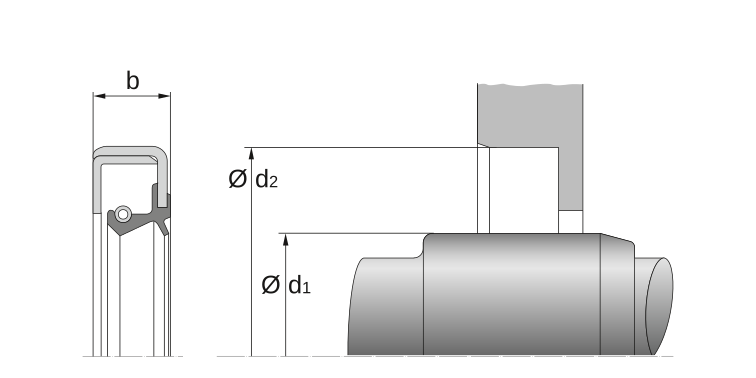
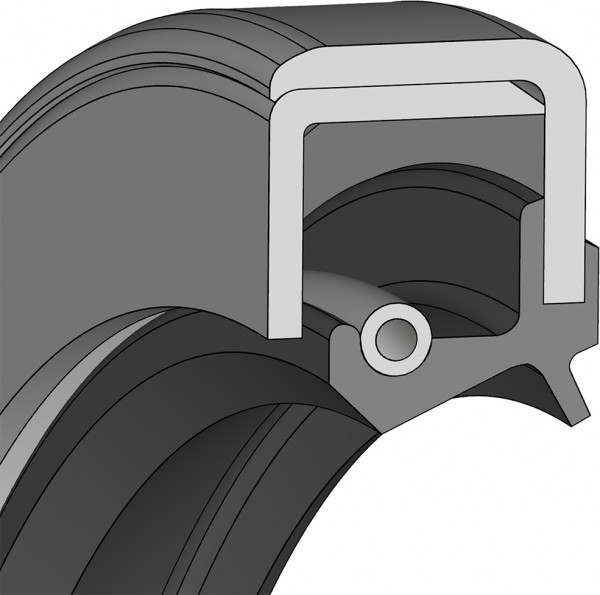
The WCS shaft seal consists of a spring-loaded main sealing lip, an additional protective lip, a closed metal outer casing and a reinforcing plate. The sealing section is made of NBR. Unalloyed steel according to DIN EN 10139, formerly DIN 1624, is used for the reinforcing plate. The garter spring is made of spring steel according to DIN EN 10270-1.
The main sealing lip provides dynamic and static sealing around the shaft. The protective lip forms an additional barrier against dust and dirt. The closed metal outer casing supports a precise interference fit in the housing bore. The reinforcing plate increases dimensional stability, which is particularly relevant for larger diameters and difficult installation conditions.
During rotation, the spring-loaded main sealing lip contacts the shaft surface. The garter spring supports the contact between the lip and the running surface. This creates a dynamic seal that is independent of the direction of rotation. When the machine is stationary, the main sealing lip continues to provide a reliable static seal.
The additional protective lip helps keep external dust and dirt away from the sealing area. The contact of both lips with the shaft causes additional friction. This increased friction can lead to a rise in temperature in the contact area. Temperature development must therefore be assessed together with speed, lubrication and the other operating conditions.
The WCS oil seal is used for sealing rotating machine components, such as shafts, hubs and shaft assemblies. The profile can be used in heavy machinery, construction machinery, agricultural machinery, rolling mills and wind turbines, among other applications. The closed metal construction with reinforcing plate makes the seal suitable for difficult installation conditions and larger diameters.
The protective lip helps protect the main sealing lip against moderate amounts of external dust and dirt. This reduces the likelihood of contaminants reaching the contact area between the main sealing lip and the shaft surface. At the same time, the metal outer casing provides a firm and precise fit in the housing bore.
Other advantages include a long service life, reliable construction, a broad range of applications and a good price-performance ratio. The WCS is suitable for moderately demanding industrial applications and is manufactured by certified external suppliers. Suitability depends on factors including the medium, pressure, temperature, circumferential speed, amount of contamination and design of the installation space.
The reinforcing plate of the WCS oil seal increases the rigidity and dimensional stability of the profile. This makes the seal suitable for larger diameters and difficult installation conditions. The rigid construction helps maintain its shape during handling and installation.
Nevertheless, the WCS must be installed carefully and evenly in the housing bore. Tilting can damage the main sealing lip, protective lip or metal outer casing. Uneven installation loads can also affect positioning. Therefore, check beforehand that the shaft and housing comply with the specified tolerances, hardness and surface requirements. A correctly prepared installation space supports a firm fit and reliable operation.
The additional protective lip of the WCS is designed to keep moderate amounts of external dust and dirt away from the sealing area. The lip forms an additional barrier in front of the spring-loaded main sealing lip. This protects the running surface of the main seal against contamination.
The protective effect depends on the amount and type of contamination, the circumferential speed and the condition of the shaft surface. Because the protective lip also contacts the shaft, additional friction is generated. This friction can cause a rise in temperature. Therefore, check whether the protective lip and maximum circumferential speed of 8 m/s are suitable for the operating environment and thermal load of the application.
The WCS oil seal has a closed metal outer casing with an additional reinforcing plate. This construction provides a firm and precise fit in the housing bore. The oil seal is installed with an interference fit in the installation space. The increased rigidity supports dimensional stability during installation and operation.
The rigid design is suitable for difficult installation conditions and larger diameters. For a reliable fit, the dimensions and surface quality of the housing bore must comply with the specified values. The housing must comply with ISO H8 tolerance and have a surface roughness of Rz 10 to 20 µm.
The metal outer casing provides only limited sealing performance with low-viscosity and gaseous media. Sealing along the outside is also limited in split housings. Therefore, assess in advance whether the outer casing construction is suitable for the medium and housing design. A precisely finished and undamaged bore is necessary to support the firm fit of the WCS.
The closed metal outer casing of the WCS provides a firm and precise interference fit in the housing bore. This keeps the radial shaft seal correctly positioned during operation. The reinforcing plate increases rigidity and supports a stable shape.
For a correct fit, the housing bore must comply with ISO H8 tolerance. The specified surface roughness is Rz 10 to 20 µm. Check the bore beforehand for dirt, burrs and damage. Incorrect dimensions or unsuitable surface quality can affect installation and sealing performance. The complete installation space should preferably be designed in accordance with DIN 3760.
The closed metal outer casing of the WCS provides a precise fit but offers limited sealing performance with low-viscosity and gaseous media. Static sealing along the outside can also be limited in split housings.
When selecting the seal, the function of the main sealing lip should therefore not be the only consideration. The medium and housing construction are also determining factors. Check whether the fit and surface quality are sufficient for the intended application. The housing bore must comply with ISO H8 tolerance and have a surface roughness of Rz 10 to 20 µm. Suitability must be tested under the actual operating conditions.
The sealing section of the WCS oil seal is made of NBR. The material can be used at temperatures from -40 to +80 °C and can withstand temperatures up to +100 °C for short periods. The maximum circumferential speed of the WCS profile is 8 m/s.
NBR offers good chemical resistance to various mineral oils and greases, including hydraulic fluids of types H, HL and HLP. The material can also be used with fire-resistant hydraulic fluids of types HFA and HFB. For HFC fluids, a maximum temperature of approximately +50 °C applies. When in contact with water, the maximum temperature is +60 °C.
NBR has low resistance to ozone, weathering and ageing. This must be taken into account when the seal is exposed to environmental influences. The additional friction caused by the protective lip can also lead to a local increase in temperature. The maximum pressure, temperature and circumferential speed cannot necessarily be reached simultaneously. Therefore, always assess the complete combination of medium, load and environmental conditions.
A WCS oil seal made of NBR is suitable for a temperature range of -40 to +80 °C. For short periods, the material can withstand temperatures up to +100 °C. The maximum circumferential speed of the profile is 8 m/s.
The stated values are maximum operating limits and cannot necessarily be reached simultaneously. The protective lip causes additional friction on the shaft, which can increase the temperature in the contact area. Pressure, lubrication, diameter and the medium also influence the actual thermal load. Therefore, assess the operating conditions as a whole and test whether the WCS provides sufficient sealing within the application without causing an unacceptable increase in temperature.
NBR offers good chemical resistance to various mineral oils and greases and to hydraulic fluids of types H, HL and HLP. Use with fire-resistant HFA and HFB fluids is also possible. For HFC fluids, a maximum temperature of approximately +50 °C applies. Water can be used up to a maximum temperature of +60 °C.
The material has low resistance to ozone, weathering and ageing. Prolonged exposure to these environmental factors can affect the material properties. Therefore, check both the process medium and the environment in which the WCS is used. The specific compound must be suitable for all media and operating conditions present.
For reliable operation of the WCS shaft seal, the maximum pressure, temperature and circumferential speed must be observed. The maximum permissible pressure is 0.05 MPa. The NBR sealing material has a temperature range of -40 to +80 °C. For short periods, NBR can withstand temperatures up to +100 °C. The maximum circumferential speed is 8 m/s.
These values are maximum limits and cannot necessarily all be reached simultaneously. The protective lip contacts the shaft and therefore causes additional friction. This friction can lead to an increase in temperature. As a result, the local temperature at the sealing lips may differ from the ambient temperature.
The medium, lubrication, diameter, installation space and condition of the shaft and housing also influence practical suitability. Therefore, always assess the complete combination of operating conditions. The suitability of the selected WCS oil seal must be checked and tested within the final application. This helps determine whether the dimensions, material, protective lip and rigid construction are correctly matched to the operating environment.
The WCS radial shaft seal can be used at a maximum pressure of 0.05 MPa. The maximum permissible circumferential speed is 8 m/s. These limits apply in combination with the temperature range of the NBR sealing material.
The maximum pressure, temperature and circumferential speed must not automatically be combined. The additional protective lip increases friction on the shaft surface and can therefore generate additional heat. Diameter, lubrication and the medium also influence the permissible load. Therefore, assess the complete application and test whether the WCS functions reliably under actual operating conditions without causing an unacceptable increase in temperature.
The available approvals and certificates depend on the specific NBR compound from which the WCS oil seal is manufactured. Therefore, the same certification does not automatically apply to every NBR version. When a specific approval or conformity is required for an application, this must be checked separately for the selected compound.
Consult the current material data sheet for the relevant compound. This specifies which approvals and certificates apply to the material. The general material designation NBR alone is insufficient to determine whether the oil seal meets a specific certification requirement. Always check this before selecting or ordering the WCS.
The installation space for the WCS oil seal should preferably be designed in accordance with DIN 3760. Correct dimensions and surface quality of the shaft and housing bore are important for the operation of the main sealing lip, protective lip and closed metal outer casing.
Shaft roundness must comply with tolerance class IT8. The shaft must be free from twists, burrs and other damage that could damage the sealing lips during installation or operation. The shaft surface must have a roughness of Rz 1.0 to 4.0 µm. The minimum hardness of the shaft surface is 45 HRC. The shaft dimensions must comply with ISO h11 tolerance.
The housing bore must comply with ISO H8 tolerance. The specified surface roughness of the housing is Rz 10 to 20 µm. These requirements support a firm interference fit of the closed metal outer casing. A damaged running surface, incorrect fit or unsuitable surface roughness can affect sealing and protective performance. Therefore, check the complete installation environment before installing the WCS.
The shaft on which the WCS oil seal is installed must comply with ISO h11 tolerance. Roundness must comply with tolerance class IT8. The running surface must be free from twists, burrs and damage. Such imperfections can damage the main sealing lip or protective lip and reduce the performance of the profile.
The shaft surface must have a roughness of Rz 1.0 to 4.0 µm. The minimum surface hardness is 45 HRC. Check these values before installation and clean the running surface carefully. A correctly finished shaft surface supports contact with both sealing lips and helps prevent excessive wear, leakage and additional heat generation.
The housing bore for the WCS oil seal must comply with ISO H8 tolerance. The surface roughness of the housing must be between Rz 10 and 20 µm. The complete installation space should preferably be designed in accordance with DIN 3760.
These dimensional and surface requirements are important for the closed metal outer casing and reinforcing plate. The WCS is installed in the housing with an interference fit. A correctly dimensioned bore supports firm and precise positioning. Check the housing beforehand for dirt, metal chips, burrs and damage. Also take into account the limited sealing performance with low-viscosity and gaseous media and in split housings.
Clean the installation space thoroughly before installing the WCS oil seal. Completely remove dust, dirt, metal chips and other contaminants. During installation, do not pull the seal over sharp edges, threaded ends or recesses such as keyways. If such areas cannot be avoided, they must be covered with a suitable installation sleeve.
Do not grease the WCS oil seal or installation space before installation. Position the seal carefully and straight on the shaft. The oil seal must not tilt during installation. Applying the installation load evenly helps prevent damage to the main sealing lip, protective lip and metal construction.
Store WCS oil seals at a temperature below +25 °C. Do not expose the seals to direct sunlight or direct heat sources. Prevent condensation in the storage area and protect the products against ozone and ionising radiation. These storage conditions are based on the recommendations of ISO 2230. A suitable storage environment helps preserve the properties of the NBR until installation.
Before installation, clean the shaft, housing bore and complete installation space. Remove dust, dirt, metal chips and other particles that could damage the running surface, sealing lips or metal outer casing. Do not pull the WCS over sharp edges, threads or keyways. Use an installation sleeve where necessary.
Do not grease the seal or installation space before installation. Position the WCS carefully and straight on the shaft and prevent it from tilting. Also check that the shaft and housing comply with the specified tolerances, hardness and surface roughness. Careful installation supports a correct fit and reliable operation of both sealing lips.
Store WCS oil seals at a storage temperature below +25 °C. Keep the seals away from direct heat sources and do not expose them to direct sunlight. The storage area must be dry and free from condensation. In addition, protect the oil seals against ozone and ionising radiation.
These conditions are important because NBR has low resistance to ozone, weathering and ageing. A suitable storage environment helps prevent unnecessary exposure to heat, light, moisture or radiation. This helps preserve the properties of the sealing material as effectively as possible until the WCS is installed. The storage conditions are based on the recommendations of ISO 2230.
When selecting a WCS oil seal, the dimensions, NBR sealing material and operating conditions must be assessed together. First, determine the required inside diameter, outside diameter and width for the shaft and housing bore. Next, assess whether NBR is suitable for the medium, temperature and environmental influences present.
Check that the maximum pressure of 0.05 MPa and maximum circumferential speed of 8 m/s are not exceeded. Take into account the temperature range of -40 to +80 °C and short-term resistance up to +100 °C. Also assess the additional friction and possible temperature increase caused by the protective lip.
Check whether the protective lip provides sufficient protection against the amount of dust and dirt in the operating environment. Also take into account the limited sealing performance with low-viscosity and gaseous media and in split housings. The tolerances, hardness and surface roughness of the shaft and housing must comply with the technical requirements. If a specific certification is required, this must be checked separately for the selected compound.



 Nederlands
 Deutsch